


Why I Built This
Early in my career, I wasn’t trying to build a framework. I was trying to survive one.
I was inside organizations trying to protect my project managers from unrealistic expectations, help leadership make better decisions, and hold everything together while the pushback came from every direction — executives who wanted visibility without process change, PMs who were drowning in manual status work, and teams who weren’t sure why any of this mattered to them. Everyone around me was announcing transformations. I was trying to keep the plane in the air while quietly fixing the engine.
What I watched, over and over, was the same pattern. A new initiative would launch with energy and executive sponsorship. Big rollout. Big training event. Big expectations. And then, six months later, the same problems — because the tools were never connected to people’s daily routines. The transformation was announced. The adoption never happened. Different tool name. Same failure.
What I figured out — the hard way, across enough organizations to know it wasn’t a coincidence — is that the only approach that actually works looks nothing like a launch. It looks like building behind the scenes first. Proving it works before anyone is watching. Showing real value to one team, one department, and letting that momentum speak for itself. Then expanding from there, incrementally, at a pace the organization can actually absorb.
That approach wasn’t academic. It was earned — one organization at a time.
That’s the Ultimate PMO Roadmap. Twenty-plus years of real-world adoption patterns, built for organizations of any size, at any skill level, at whatever pace fits their reality.
Does Any of This Sound Familiar?
Before getting into what the roadmap does, it is worth asking whether you recognize the environment it was built for.
Leadership is under pressure to do more with less — sometimes literally fewer people. Headcount gets trimmed two or three percent and the expectation is that output stays the same or grows. Nobody is modeling what that actually costs in capacity, risk, or delivery timelines. The cuts happen and the consequences show up later as surprises.
New tools get purchased without IT involvement, sometimes without even a proper evaluation, because a vendor made a compelling demo to the right executive. Now IT is expected to support and integrate something they never approved, on top of an environment they have already been asking for budget to stabilize. The duct tape goes on. The outages happen. Everyone wonders why.
The PMO works heroically to hold it all together. Status gets collected manually. Reports get assembled the night before the meeting. PMs spend more time formatting slides than managing projects. And when things go wrong — and they do go wrong — there is no data trail to show what the real constraints were, what tradeoffs were made, or what would have happened with different decisions. So leadership loses confidence. And the PMO Director, unable to prove the value of what the team is doing or show the impact of the decisions being made above them, gets replaced. On average, every three years. A new leader comes in, inherits the same structural problems, and the cycle starts again.
That is not a technology problem. It is a foundation problem.
If any of this sounds familiar, you are not alone. It is the most common PMO story I have heard across two decades of working inside organizations of every size. And it is exactly the problem the Ultimate PMO Roadmap was designed to solve — not with a bigger announcement, but with a better foundation.
What You Can Expect
When the right foundation is in place, everything changes. Here is what that looks like.
Project status meetings stop rehashing the past.
Instead of spending the first half of every meeting reconciling last week’s data and trying to agree on what actually happened, your team arrives already current. The conversation moves forward — to decisions, options, and next steps. Teams consistently see a 75% reduction in time spent per project status meeting, per person. That compounds fast across a portfolio.
Your data gets trusted.
Not just by you — by leadership. When the numbers in the report match what is actually happening on the ground, people stop maintaining shadow spreadsheets. The PMO stops being a reporting function and starts being a source of truth.
Resource decisions get made before they become crises.
You have real visibility into both project demand and non-project work — baselined and tracked — so you see overallocation building before it overloads your team. The capacity conversation happens in advance, with data behind it, not after the damage is done.
The PMO becomes a strategic voice, not an order-taker.
This is the shift that changes everything. When the PMO identifies a delay, a resource conflict, or a risk to a strategic priority months before it becomes a crisis — and walks in with options and a clear recommendation — something changes in the room. Leadership stops questioning the data. They stop trying to manage the details themselves. They start asking the PMO what should happen next. The PMO earns its seat at the decision-making table — not because it asked for one, but because it built something that deserved it.
The PMO Trust Approach
Everything in the Ultimate PMO Roadmap is built around what I call the PMO Trust Approach — two engines that, working together, produce the one outcome every PMO is ultimately hired to deliver: trust.
Transparency is the first engine. It means your project schedules, deliverables, issues, and risks all live in one place — not four separate systems that need to be reconciled, not imports and exports that are already stale by the time someone reads them. One environment where everything connects and updates together. Issues and risks are tagged directly at the task and deliverable level, categorized by type, and tied to their cost, work, and date impacts. When a task slips, the ripple moves through the entire schedule automatically — dates cascade, costs update, resource demand shifts. You see the real picture in real time, without anyone manually recalculating anything.
Traceability is the second engine. It means visibility is connected in every direction. Issues and risks are not tracked in a separate system and linked back — they live inside the schedule itself, at the task and deliverable level. When something threatens a date, a cost, or a deliverable, you see it at the source. That impact traces upward through the program and into the portfolio. But it also moves horizontally — a Resources risk that affects three months of work does not just show up on one project. It surfaces across every schedule it touches, accumulated and categorized so you see the true portfolio-wide impact. Categories like Scope Change, Vendor, or Originality — meaning “we have never done this before” — can suddenly appear across six projects at once and tell you something your status reports never would. What-if scenarios let you model outcomes before committing to a path. The impact of a delay, a resource loss, a shift in priorities — you see it before you are living it.
Trust is the outcome — and it is earned proactively, not reactively. It does not come from a presentation or a promise. It comes from the PMO identifying a challenge months in advance, walking in with options and a clear recommendation, and being right often enough that leadership stops questioning and starts relying. The PMO stops being managed and starts doing the managing. That shift — from order-taker to strategic voice — is what the PMO Trust Approach is designed to produce.
Now here is where a lot of organizations get derailed before they ever get close to that outcome. The market is full of tools right now that treat every task as a list item and measure success by how fast boxes get checked. A completion rate is not a schedule. It does not tell you how many people of a specific role you are over or under-allocated. It does not tell you where you could invest to accelerate a program or what it would cost to hit a future date. Velocity is only meaningful when it is connected to real people, real capacity, and real dates — and that connection is exactly what the PMO Trust Approach is built to create.
The Framework: Four Capabilities
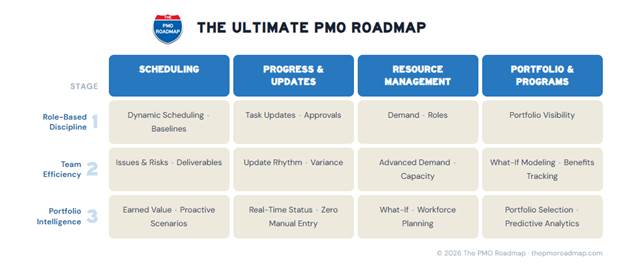
The roadmap is built around four core capability areas. They are not independent — each one builds on the one before it in a specific sequence. Scheduling enables reliable Progress & Updates. Reliable Progress & Updates makes Resource Management meaningful. And all three together are what unlock Portfolio & Programs. The sequence is the point.
Scheduling is where everything starts. Are your project managers building dynamic schedules where one task moves and everything — dates, costs, resource demand — adjusts automatically? Or are they managing static lists that require manual updates after every change? Dynamic scheduling is not a feature. It is the engine that powers every other capability in this roadmap. Without it, progress reporting is manual, resource visibility is guesswork, and portfolio decisions are built on stale data.
Progress & Updates becomes reliable once scheduling is dynamic. When schedules are structured correctly, status flows automatically — no manual assembly before meetings, no chasing down updates. Reports become trusted instead of questioned. This is where the 75% reduction in project status meeting time becomes real, per project, per person.
Resource Management becomes meaningful once progress is reliable. And this is where the architecture matters. Projects, tasks, assignments, units, and individual resource calendars — all native, all in the same environment, no plugins, no separate modules, no additional licensing. The same single-tool principle that applies to issues and risks applies here. You gain full visibility into both project and non-project work, baselined and tracked, so you see overallocation building before it becomes a crisis. Resource conversations shift from reactive firefighting to proactive planning.
Portfolio & Programs is where it all comes together. With dynamic schedules, trusted reporting, and real resource visibility in place, leadership can make prioritization decisions on live data — modeling the impact of shifting a priority, accelerating a program, or changing the level of investment across the portfolio. Strategic conversations start from a position of clarity, not a week of manual preparation.
How Value Grows
Each capability area is developed through three intentional value stages. These are not maturity levels you can skip to — each one builds the foundation the next requires. The fastest path to 10× always runs through 1×. That is not a limitation. It is the design.
1× — Role-Based Discipline (Individual value)
This is where routines form and discipline takes hold. Tools are in place, processes are being followed consistently, and individual PMs and team members are building the routines that everything else depends on. A concrete example of what this feels like: a dependency shifts and your schedule updates automatically instead of requiring a manual rebuild. That sounds small. It is not. It is the difference between a schedule that is managed and a schedule that manages itself. The value at this stage is contained — and that is exactly right. You are not trying to scale yet. You are building the foundation that makes scaling possible. Organizations that take 1× seriously get to 10× faster than organizations that rush past it. Every time.
3× — Connected Efficiency (Shared value)
This is where value starts multiplying across roles. A PM updates a schedule and a resource manager sees demand shift automatically. A status update flows into a trusted report without anyone manually assembling it. Project status meetings shrink in duration, frequency, and the mental load they carry for everyone involved. Information moves across the organization instead of sitting in silos. The whole becomes greater than the sum of its parts — and people start to notice. The 1× foundation is what makes this possible. Without it, 3× never holds.
10× — Portfolio Intelligence (Organizational leverage)
This is where the PMO becomes a strategic force. Leadership is making prioritization decisions on live data. Portfolio scenarios — what happens if we shift resources here, invest more there, accelerate this program, delay that one — run in real time. Resource forecasting is predictive, not reactive. The PMO is not delivering reports anymore. It is delivering recommendations. How do we hit that date? Where should we invest to go faster? What is the risk of waiting? Which path gives us the best outcome given what we know right now? This is where the real return on investment lives — and it is where organizations stay once they get here.
What Makes This Different: The Five Game Changers
A lot of roadmaps describe what good looks like. These five things are what actually get you there.
- Role-Based Training Led by Dale Howard — Microsoft MVP
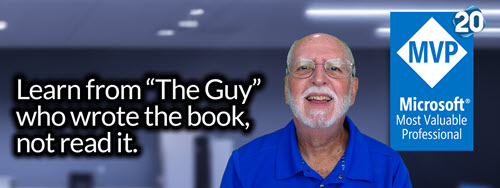
Most organizations learn Microsoft Project from someone who learned it from Dale Howard. With the Ultimate PMO Roadmap, your team learns directly from the source. Dale has been a Microsoft MVP for over 20 consecutive years, has authored more than 20 books on Microsoft Project, and has spent decades answering questions, building curriculum, and helping project managers and schedulers around the world build real skills. Nearly 200 YouTube videos. Decades of community leadership. The most trusted name in Microsoft Project — period. In-person, virtual, or on-demand, the training is built around your roles, your schedule, and your reality. This is not a generic course. It is the foundation the entire roadmap is built on. Learn from the guy who wrote the books, not someone who read them.
- Expert Coaching and Mentoring for Every Role
Training alone does not create transformation. What makes skills stick is having expert guidance available in the context of your actual work — when the real questions come up, not just in the classroom. From project managers to resource managers to executive sponsors, every role gets the right coaching at the right time. Change gets absorbed instead of abandoned.
- Preconfigured Environments That Deliver Fast Results
You are not starting from a blank slate. Your environment is configured from the start — Microsoft Project Desktop, Teams integration, traceable issues and risks, major deliverables mapped, live reports and dashboards, quality reporting, and participation tracking already in place. No integrations. No imports or exports. No months of configuration. You are up and running in two weeks or less, on the most proven project scheduling platform in history. Microsoft Project is celebrating its 40th year. Project Server has been the enterprise standard for over 20 of them. Your IT team already knows how to support it. Your data stays in your environment. You are not betting your PMO transformation on a startup.
- Traceable Participation Metrics That Drive Adoption
Most roadmaps stop at process. This one tracks whether people are actually following it. Real-time participation metrics show you who is adopting, who is struggling, and where to focus coaching support — before momentum is lost. You cannot manage what you cannot see, and adoption is no exception.
- Scalable Rollout That Fits Your Reality
Some organizations start with three project managers. Others with a single department. A few go enterprise-wide from day one. The roadmap does not care where you start — it cares that you start right. Roll out in phases. Scale naturally. No added tools, no surprise licenses, no unnecessary complexity. The pace is yours, and the path is proven.
Where to Start
There is one place the roadmap always begins, regardless of organization size or where your team is today: Dale Howard’s training on dynamic scheduling.
If a task slips and nothing else moves, you do not have a schedule. You have a wish list. Dynamic scheduling means one change cascades automatically — dates adjust, costs update, resource demand shifts. It is the engine that powers everything else in the roadmap, and it has to be built right before anything else is worth attempting. Dale’s curriculum is how you build it right.
Almost everyone in the Microsoft Project space has learned from Dale directly, learned from someone who did, or read one of his books. The difference here is simple: your team learns from the guy who wrote them. In-person, virtual, or on-demand — the training meets you where you are.
Once dynamic scheduling is working consistently across your PMs, the question becomes: is that discipline connecting upward into your programs and portfolio? Are leadership’s decisions being made on live data? Are resource and cost impacts visible before they become problems?
If the answer to all of that is yes — if your schedules are dynamic, your reporting is trusted, your resources are fully visible across project and non-project work, and your portfolio decisions are running on real data — you are operating at a level most organizations never reach. That is genuinely elite company, and it represents exactly what the best-run PMOs in the world look like.
The Ultimate PMO Roadmap exists for every organization that is not there yet — and wants a clear, proven, step-by-step path to get there.
Not Sure Where You Stand?
Start with a free 30-minute PMO Assessment. We will look at where your organization is across the four capability areas, identify your biggest constraint, and give you a clear picture of what the path forward looks like — no pitch, no pressure.
Schedule your free PMO Assessment at www.thePMORoadmap.com
Tony Proctor is a Microsoft PPM consultant with 20+ years of experience helping organizations build PMOs and ePMOs on Microsoft Project Server and Office 365. He is the founder of The PMO Roadmap and The AI Roadmap.
Author Profile

- Navy Veteran, PMO, AI Evangelist, Microsoft Project Server, Microsoft Project, Power BI and everything M365.
Latest Entries
 PMO RoadmapsApril 22, 2026Project Server Resource Management or Demand Management? You Need Both
 PMO RoadmapsApril 22, 2026Why PMO Transformations Fail—and the PMO Roadmap That Makes You Successful
 PMO RoadmapsApril 22, 2026Microsoft Planner Agent Shows the Real Risk of AI in Project Management: No Baseline
 PMO RoadmapsApril 21, 2026Build Your Free Copilot App for Your PMO
